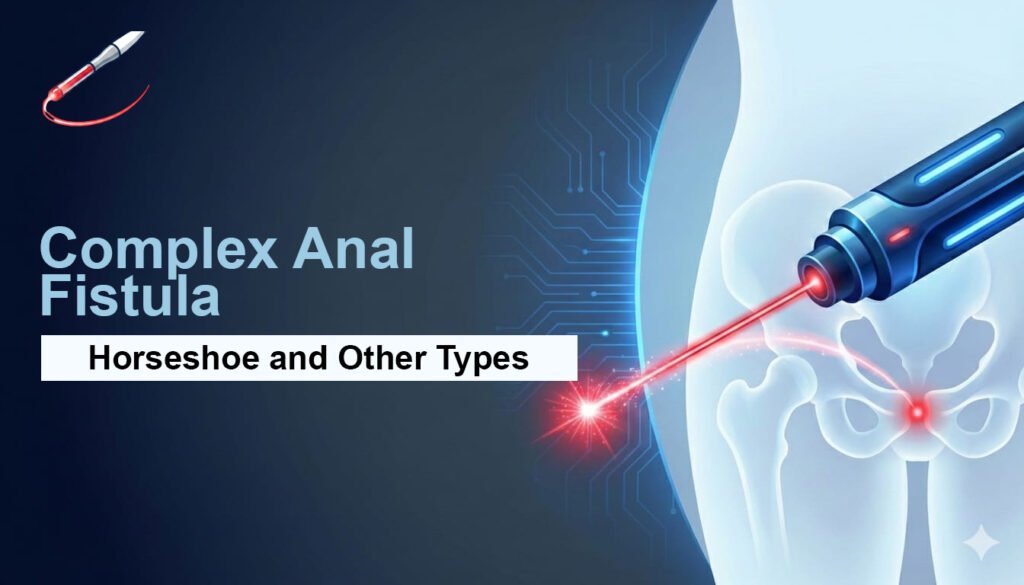
Complex anal fistula is not like simple ones that heals easily with basic procedures. When patients present at Karachi Piles Clinic with horseshoe fistula or complex branching tracks, it is clear this is going to need careful planning and advanced treatment methods. These aren’t the straightforward cases – they’re the ones that keeps surgeons thinking carefully.
In Karachi, many patients present at specialised clinics after trying multiple surgeries that didn’t worked. They’ve been suffering for years, going from one doctor to another. Some has lost hope completely. But with modern laser techniques, we now has much better options for treating even the most complicated fistula cases. Here is an explanation of what makes these cases complex and how we manage them today.
What exactly makes a complex anal fistula different from simple one?
A complex anal fistula involves more than just one simple track between the inside of your anal canal and outside skin. These fistulas has multiple branches, like tree roots spreading in different directions. They often goes through or around your sphincter muscle – the muscle that controls your bowel movements. Some has extensions high up in the pelvis or creates horseshoe pattern around the entire anal opening.
Simple fistulas are straightforward – one track, clear path, easy to treat. But complex ones? They’re completely different beast. in clinical experience treating patients over past years, complex anal fistula usually have at least one of these characteristics: multiple openings on the skin, branches going in several directions, involvement of significant portion of sphincter muscle, previous failed surgeries that created scar tissue, or connection to deeper pelvic spaces.
The challenge with complex cases is that aggressive surgery can damage your sphincter muscle permanently, leaving you with incontinence – meaning you can’t control your bowel movements properly anymore. This is devastating complication that ruins quality of life. So we need treatment approaches that heals the fistula while protecting muscle function. What do you think is more important – closing the fistula or maintaining your ability to control bathroom functions? Both matters equally, right?
For the complete guide to fistula classification, diagnosis, and treatment options, see our laser treatment for anal fistula guide.
How does horseshoe fistula treatment differ from other complex anal fistula?
Horseshoe fistula is particularly tricky type of complex fistula. It literally forms horseshoe shape around your anus, with one internal opening and the track spreading in both directions around the anal canal, sometimes with multiple external openings. Experienced surgeons have treated many such cases in Karachi, and each one needs very individualized approach.
These fistulas usually originates from deep gland infection in the back portion of the anal canal. The infection then spreads sideways in both directions, creating that characteristic horseshoe pattern. Traditional surgery for horseshoe fistula was quite extensive – cutting through lot of tissue, long healing times, and significant risk of sphincter damage leading to incontinence.
Modern Advanced Laser Techniques has changed how we approache these cases completely. Instead of laying open the entire horseshoe track, we can now treat different portions separately, using combination of drainage, laser ablation, and sphincter-preserving methods. The key is proper planning based on detailed imaging.
What laser treatment options exists for complex anal fistula cases?
Laser treatment for complex anal fistula has evolved significantly in recent years. The main approach we use is called FiLaC – Fistula Laser Closure. This technique uses laser energy to destroy the fistula track from inside without cutting through surrounding tissues. It’s sphincter-saving procedure, which is crucial for complex cases.
For a head-to-head comparison of laser versus traditional surgery outcomes, see FiLaC vs fistulotomy — success rate comparison.
For complex anal fistula, we often combines different techniques. Sometimes we drain abscesses first, allows inflammation to settle down, then does staged laser treatment. Other times we use seton placement (a surgical thread) to gradually cut through minimal muscle while the laser treats the internal portion. Each case is unique.
FiLaC for Complex Cases works by inserting laser fiber directly into the fistula track. The laser energy seals the track from inside by causing controlled thermal damage that promotes healing. The surrounding sphincter muscle stays protected because we’re not cutting through it. Recovery is much faster compared to traditional surgery, and patients usually goes back to work within few days.
In clinical opinion, the biggest advantage of laser treatment for complex cases is that it can be repeated if needed. If first treatment doesn’t completely heals the fistula, we can do another session without causing additional muscle damage. Traditional surgery doesn’t gives you this flexibility – once you cut the muscle, it’s done.
How important is MRI before treating complex fistula?
Extremely important, I would say. Without proper MRI evaluation, treating complex anal fistula is like driving in Karachi without GPS during rush hour – you might eventually reach destination, but you’ll probably takes many wrong turns and wastes lot of time. MRI shows us exactly where all the tracks go, how many branches exists, which muscles are involved, and whether there’s any hidden abscess pockets.
I never operate on complex anal fistula without recent MRI scan. MRI Evaluation gives me roadmap for surgery. It shows extensions I wouldn’t be able to see or feel during physical examination. Many times, what seems like simple fistula on examination turns out to have multiple hidden branches on MRI. Imagine operating without knowing this – you’d miss branches, and the fistula would come back.
For horseshoe fistula especially, MRI is absolutely essential. It shows the exact extent of horseshoe, where the primary opening is, and whether both arms of horseshoe are equally developed or one side is more extensive. This information directly affects how I plan the treatment approach.
What are the success rates of laser treatment for complex cases?
Success rates varies depending on how complex the fistula is. For moderately complex cases, we see healing rates around 80-85% with single laser treatment. For very complex or horseshoe fistulas, initial success might be 65-75%, but with staged treatments or combination approaches, we can gets overall success up to 90-95%.
These numbers might seems lower than simple fistula treatment, but here’s important context – traditional surgery for complex cases also has similar or even lower success rates, AND it carries much higher risk of incontinence. So laser treatment gives comparable healing with much better functional outcomes.
Clinical observation shows in clinical practice that patients who follows post-treatment instructions carefully has better outcomes. This includes keeping area clean, taking prescribed antibiotics, avoiding straining during bowel movements, and coming for regular follow-ups. Also, patients who stops smoking heals much better – smoking really affects wound healing badly.
Why is sphincter preservation so critical in complex fistula surgery?
Your anal sphincter is like gatekeeper that controls when you go to bathroom. It has two layers – internal sphincter (involuntary muscle you can’t control) and external sphincter (voluntary muscle you can control). Complex fistulas often goes through portions of these muscles. If surgeon cuts through too much muscle during treatment, you loses control.
Clinical experience shows patients who had traditional fistulotomy (laying open procedure) for complex fistula and ended up with varying degrees of incontinence. Some can’t control gas, some leaks liquid stool, some has complete loss of control. This is life-changing complication that’s very difficult to fixes later. Sphincter Protection is therefore the top priority in complex cases.
Laser treatment and other sphincter-saving techniques prioritizes muscle preservation. We might accept slightly lower healing rate to ensures you maintain normal bowel control. What’s the point of closing fistula if you can’t control your bowel movements afterward? That’s trading one problem for another, possibly worse problem.
What should patients expects during recovery from laser treatment?
Recovery from laser treatment for complex fistula is generally much easier than traditional surgery. Most patients I treats at Hospital goes home same day or next morning. Pain is usually manageable with oral painkillers – nothing like the severe pain after traditional fistula surgery.
You’ll need to keep the area very clean. We recommend washing with plain water after each bowel movement, or using handheld shower if available. Sitz baths (sitting in warm water) helps a lot with comfort and healing. Many Karachi patients asks me if they can use Pakistani-style bathroom (squat toilet) – yes, you can, but be gentle and don’t strain.
For first week, you might see some discharge from the fistula openings. This is normal as the treated track is healing and draining out. Some bleeding can occur too, usually minimal. We give antibiotics to prevent infection. Most patients returns to office work within 3-5 days, though we recommend avoiding heavy lifting or strenuous exercise for 2-3 weeks.
Follow-up is very important. I usually see patients at 1 week, 4 weeks, and 3 months after procedure. We check healing progress, looks for any signs of recurrence, and makes sure you’re not having any complications. Some complex cases needs second treatment session after 8-12 weeks if first treatment didn’t completely closed all tracks.
How do we decide between laser and traditional surgery for complex cases?
This decision depends on several factors that we evaluate together. Understanding different Fistula Types helps in making right choice for each patient. Location of fistula matters – if it’s very low and superficial, traditional fistulotomy might still be reasonable option. But if significant muscle is involved, laser or other sphincter-saving approach is better.
Previous surgery also affects decision. If you’ve already had multiple failed procedures, scar tissue makes traditional surgery more risky and less likely to succeed. Laser treatment works well in previously operated cases because it doesn’t relies on cutting through scarred tissues. Your general health plays role too – patients with diabetes, inflammatory bowel disease, or other conditions affecting healing might does better with less invasive laser approach.
Cost is practical consideration in Karachi. Laser treatment is more expensive initially than traditional surgery. However, when you consider faster recovery, less time off work, lower risk of complications requiring additional treatments, and better quality of life outcomes, it often works out more cost-effective in long run. Complex Fistula Treatment options should be discussed thoroughly before making decision.
Age and activity level matters too. Younger, active patients usually want sphincter-preserving approach to maintains their lifestyle. Older patients might prioritize definitive healing over preservation, though we still tries to save muscle function whenever possible.
What makes certain surgeons better equipped to handles complex cases?
Experience with complex cases is crucial. Not all surgeons regularly treats complex and horseshoe fistulas. In Karachi, many general surgeons see mostly simple cases, and when complex one comes, they might not have enough experience with advanced techniques. Clinical observation shows that surgeons who specializes in proctology and sees high volume of fistula cases gets better outcomes.
Access to proper equipment matters significantly. Laser treatment requires specialized laser machine and trained team. MRI-guided treatment planning needs radiologist who understands fistula anatomy. Not all hospitals has these facilities. Having operating room equipped for complex proctology procedures makes difference in outcomes.
Willingness to use staged approach is sign of experienced surgeon. Sometimes trying to fixe everything in one surgery leads to complications. Breaking treatment into stages – first drainage, then definitive treatment after inflammation settles – often gives better results for very complex cases. Knowing when to be patient rather than aggressive comes with experience.
Seeking Advanced Surgical Cases expertise when you have complex or recurrent fistula can save you from multiple failed treatments and potential permanent complications. Don’t hesitate to ask your surgeon about their experience specifically with complex cases, success rates, and complication rates.
Bottom Line: Complex and horseshoe fistulas are challenging conditions that requires specialized expertise and modern treatment approaches. Laser treatment offers excellent option for managing these cases while preserving sphincter function and quality of life. Proper evaluation with MRI, careful treatment planning, and experienced surgical hands makes all difference between success and failure. Don’t settle for repeated surgeries that aren’t working – explore laser and other sphincter-saving options with specialist who regularly treat complex cases. Remember, protecting your muscle function is just as important as closing the fistula itself.